Monday, 17 October 2011

John Henry Alexander

Actor, laterally owner and manager of the Theatre Royal in Dunlop Street, Glasgow was born in the
seaside town of Dunbar in East Lothian, Scotland.

The IGI (www.familysearch) lists his birth as 30th July 1796 (christening on 7th August 1796)
The same source lists his parents, John Alexander and Margaret  Pitcaithley
as having an additional 3 sons:
William Alexander, born 17th June 1791, christened 19th June 1791 at Perth
William Stewart Alexander, born 18th August 1794, christened 24th August 1794 at Dunbar
Charles Alexander, born 19th October 1798, christened 28th October 1798 at Dunbar

(His obituary states that he was one of five sons)

John married Elizabeth Riddell, daughter of George Riddell, Coach Builder and Mary Learmonth
at Edinburgh in May 1817 and went on to have 5 (known) children:
George Russell Alexander, born 11th December 1820 at Edinburgh
(Died 17th June 1901)
Elizabeth Alexander, born ?, christened 29th October 1826, at Dumfries
Margaret Alexander, born 3rd January 1829, Glasgow
Janet Eliza Alexander, born 4th August 1833, Glasgow
Elizabeth Riddell Alexander, born ?, christened 19th October 1836, Glasgow.


My sincere thanks to Matthew Lloyd, great, great grandson of Horatio Lloyd
for the above excepts from original posters from the Theatre Royal in Dunlop Street.

Images of the complete posters, plus many others, can be seen here:

Some of John Henry Alexander’s ‘antics’ have been mentioned in Chapter 11
in the autobiography of H. F. Lloyd ‘The Life of an actor‘, see: http://www.arthurlloyd.co.uk/HoratioBiog/HoratioLloydAutobiographyChapter11.htm

The Glasgow Herald of Tuesday, February 19th 1849 carries a lengthy article headed as
“Frightful Accident at the Theatre Royal, Dunlop Street,
sixty-five lives lost.”
The article contains a list of persons killed and injured, listing their age, places of residence and where they died if not at the theatre (the fire had been on the night of Saturday 17th February).

On the 1851 Scottish Census, John is living at 198 Pitt Street, Glasgow.
His occupation is listed as Manager & Proprietor of Theatre Royal, Glasgow.
Also living there were wife Margaret, age 44
and daughters Margaret age 21 and Jessie age 16

(Jessie would most likely have been daughter Janet, born 1833)

John Henry Alexander died later the same year on 15th December 1851 aged 55 years and his monument in the Glasgow Necropolis must be one of the most ornate there.

The monument was designed by James Hamilton and sculpted by Alexander Handyside Ritchie.

John Henry Alexander’s Monument is located on Section ‘Omega’ of the Necropolis.

The Glasgow Herald of Friday morning, December 19th, 1851
printed the following on their front page:

  
On page 5 of the same issue, followed a lengthy obituary

The following is a transcription of the article:

Death of Mr. Alexander, of the Theatre Royal

The public will learn with much regret, of the death of Mr. John Henry Alexander, the proprietor of the Glasgow Theatre Royal. Mr. Alexander only retired from active life as Manager of the Theatre at the beginning of the present season, when Mr. Simpson became the leasee of the establishment. Freed from the pressure of his managerial duties, he proceeded on a visit to London about two months ago. Here he was suddenly taken ill, and as his malady, which at the out-set was jaundice, did not yield to medical treatment, he became anxious for removal to his own home, and was accordingly brought to Glasgow about three weeks ago. He gradually became worse, however, and finally sank under his ailments on the morning of Monday last at the comparatively early age of fifty-five. We say “comparatively early,” for Mr. Alexander has occupied a most prominent position before the Glasgow public for more than a quarter of a century; and while retiring in full mental and physical vigour, he might fondly look forward to a lengthened period of ease and contentment. But he has been summoned to his account almost without tasting the sweets of retirement which he had earned by a long life of industry and anxiety.

Mr. Alexander’s public character will be variously estimated. But we believe every one will readily concede to him the character of an honest and industrious man, and an able member of his profession. Doubtless he had certain eccentricities, which were sometimes exhibited to the amusement of his audience, but these did not in any degree mar his general merits as an excellent performer. It may be said by some that Mr. Alexander did little to elevate the character of the Glasgow stage, and that his company might have possessed a wider range of talent than it could usually boast of. Before we can speculate on this point, we would require to be in possession of information generally only known to the manager himself; and it must not be forgotten that theatricals, to be managed profitably, must be conducted like any other mercantile undertaking. Mr. Alexander afforded the Glasgow public the opportunity of seeing, at convenient seasons, the best talent which London could produce; and it is a matter of fact that his establishment was at all times conducted with the strictest regard to purity and decorum. His exertions were rewarded with complete success in a pecuniary point of view; and his name will long be remembered in Glasgow, as having erected in it the finest theatre in the British dominions, London only excepted.

Mr. Alexander commenced his theatrical career in Glasgow about 1822, when he became leasee of part of the old building which stood on the site of the present magnificent house. At the period to which we refer, the Theatre Royal, under the management of Mr. Seymour, occupied the upper floor of these premises. Mr. Alexander, in the then state of the patent laws, could not style his establishment a theatre, he therefore called it the “Dominion of Fancy”. He continued to conduct dramatic entertainments there until the opening of the Theatre Royal in Queen Street, when he became tenant or proprietor of the whole tenement in Dunlop Street.
 
His house was then known as the Minor Theatre. During this time he was leasee of the Caledonian Theatre in Edinburgh, the theatres of Dumfries, Carlisle and others. At the Minor Theatre in this city he gave melo-dramas, farces and operas; and we have to state that during this period he gave a set of musical performances, which, we believe, may be placed amongst the first operas ever represented in Glasgow. We do not clearly remember whether the French Operatic Company which performed in Queen Street were immediately before or after this period; but we distinctly remember that amongst other pieces “Der Freischutz” and “Oberon” were put on the stage. The principal vocalists were Messrs. Horncastle, Edmonds and Reynoldson, and Miss Horncastle. Following them came a rapid succession of English singers, who appeared in such pieces as “Rosina”, “Love in a Village”, “The Maid of the Mill”, and “The Quaker”. The singers who sustained the principal parts were Horn, Binge, Williamson, Shirvall, Miss Paton, Miss Eliza Paton, and the Misses Smith.


Amongst the characters in which Mr. Alexander appeared to great advantage, and in which we feel inclined to believe he had few equals and no superiors, we may mention “Jemmy Mammoth” in Douglas Jerrold’s farce of “Law and Lions”, “Adam Brock” in “Charles the XII”, which the late Mr. R. Hardy, one of his most constant castigators admitted was many degrees better than the same part as performed by Mr. Liston of London; “Demetrius” in “The Evil Eye”, “Colonel Dumas” in “The Lady of Lyons, “John Thornberry” in “John Bull”, besides many others which the old playgoers of Glasgow may remember, but which we need not particularize. His performance of “Dandie Dinmont” in “Guy Mannering” more than once received commendations from Sir Walter Scott, and in many of his other Scottish parts we are not sure that a considerable portion of the praise which has been bestowed on Mr. McKay would not, twenty years ago, have been as well applied to the subject of our memoir. In late years the multiplicity of characters, and the very different nature of the talent necessary properly to represent them, very materially altered the style of his acting. His low comedy had become broad rather than humorous, and the short time he had for study forced him sometimes to interpolate words of his own fault of those written by the author.
John Henry Alexander was born in the town of Dunbar in East Lothian, in the year 1796. His father was a respectable watchmaker in that town, and for some time conducted the establishment of a Mr. Davidson, and on that gentleman’s retiring to Dunse he succeeded to the whole of his business, which he prosecuted with success for some years; but circumstances of an adverse nature, occasioned by the pressure of the times, having overcome his efforts, he resigned his prospects in that town and came to Edinburgh, in which city he remained for some years, and from thence retired to Glasgow.


The subject of this memoir is the second son of five. Having received the principal part of his education in Edinburgh, he commenced and was intended to pursue his father’s profession; but on arrival in Glasgow he was placed in the shop of his uncle, Mr. Hugh Proudfoot, then an extensive hosier and glover at the foot of the Candleriggs, where he continued for some time as assistant shopman, to the satisfaction of his relative. But having considerable time upon his hands in the situation which he filled, he here imbibed a predilection for the stage by reading the memoirs of Garrick, Macklin, Barry, Mossop, and other eminent members of the historic art; and last, not least, his afterwards manager, Mr. Henry Johnston, whose biography met his eye in the Monthly Mirror, and, being a Scotchman, national feeling and enthusiasm at once determined him in making the stage his profession, and now busied his thoughts on the means of accomplishing his design – the fruit of which was an appearance with a party of theatrical heroes, who sallied from Glasgow to an adjoining country town, and here he made his debut as “Frederick” in the play of “Lovers’ Vows”, and “Scout” in the farce of the “Village Lawyer”. In these his success was such as to realise all the expectations he had formed of being an actor.

He afterwards, in a similar exhibition, enacted “Lady Randolph” and “Williams” in the farce of the “Register Office”, for his clear enunciation of which, and his general perfectness in the text, he was particularly noticed, and his juvenile mind was sufficiently buoyed up with applause, to confirm his choice of profession. At this period he was not more than fourteen years of age, and being in the habit of frequenting the office of the late John Tate, then printer in Glasgow, for the purpose of superintending the printing of the bills, for the above exhibitions, he there attracted the notice of that gentleman, who afterwards introduced him to Messrs. Bartley and Trueman, then managers of the Queen Street Theatre, who, perceiving something of the ‘vis comica’ in his composition, allowed him an appearance on the same evening that the son of Mr. Bartley made a similar debut – Mr. Alexander singing the comic song of ‘London is the Devil’, and Mr. B. ‘Scots wha hae wi’ Wallace bled’: the juvenility of the heroes being such, as created a powerful sensation amongst the inmates of the theatre; the wings and stage doors were crowded to hear the result of their efforts, which were highly relished by the audience, and Mr. Alexander being encored in his song, he repeated it with similar success for several evenings. After this he continued to visit behind the scenes, and to prepare himself in characters, when a maturer age might fit him for their representation. On the retirement of Messrs. Bartley and Trueman from the Glasgow Theatre, he procured an engagement from their successor, and here began to distinguish himself by giving out the performances at the end of the play, and addressing the audiences in cases of emergency. Adverse circumstances having obliged Mr. Montgomery to relinquish the theatre, he at last met with the object of his early adoration, Mr. Henry Johnston, who immediately engaged him; and he made his first appearance in the town of Ayr as Laertes in Shakespeare’s ‘Hamlet’, Johnston playing the part of Hamlet. On the second night, Dan in ‘John Bull’, and throughout the season, an extensive range of business of equal consequence – versatility of talent, which has since distinguished his efforts, appearing even at those early years. He now returned to the Queen Street Theatre under the auspices of Mr. Macready, who had then become leasee of the theatre. His entrĂ©e into that establishment was as Frank Rochdale, in ‘John Bull’, and continued till the end of the season playing a variety of business, and finished as Colonel Lambton in the ‘Royal Oak’, to Master Betty, the ‘Young Rosciue, Charles the Second’, when he was despatched with a party to open the Newcastle Theatre, where he continued several seasons, gradually working himself into favour with the audience.


He then visited Carlisle with the same company, where he became an established favourite, and has since continued to retain the favour and good opinion of that audience. While in Carlisle he received a favourable offer from Messrs. Anderson and Falconer, then managers of the Scarborough Theatre, which he accepted; but, in the interim, having been recommended by some private friend, he received a flattering invitation from Mr. William Murray to join him at the commencement of his management of the Theatre Royal, Edinburgh; having always entertained a high opinion of the respectability and excellence of this establishment, he experienced some regret at not being able to accept the offer at this time, but, in his reply, requested that the gentleman to honour him with a communication at the end of the Scarborough season, which, being complied with, after an excellent benefit in Scarborough, with equal professional success, he joined the Edinburgh company, where he continued about ten years, occupying a vast multiplicity of characters, tragic and comic; in many of which he was eminently successful, such as Dandie Dinmont, Ralph Hempseed, Jem Ratcliff etc., combining with them such characters as Pizarro. Moustache (Henri Quatre), Bertrand (Foundling of the Forest), Timour the Tartar, Zembuco etc, in all of which, the kindness of the audience was always proverbial. He took much pains and pleasure in his dressing, and discharge of his duties before the public; and the kind and continued favours bestowed upon him by an Edinburgh audience has left a strong impression upon his mind, even to this hour.

He was married in the year 1817, to the present Mrs. Alexander, who is a native of Edinburgh, when only twenty years of age; and became so extensively connected and favoured with the public, that his benefits annually produced £147. On these occasions he assumed the following important characters, - Othello, Alexander the Great, Fitzharding (Curfew), Robert Tyke, etc., etc., in all of which he raised himself still higher in the general important situation he held in the theatre; and by his industry, contrived to amass a considerable sum, such as might be termed to so young a person, and in a precarious public profession, a tolerable independency. Keeping in view his future endeavours, upon the capital of which he commenced his management, and invested his family in some property of importance on that city.

Although ten years in the Edinburgh Theatre, he quitted it for a short period, to accept of an invitation to be the stage manager of the Aberdeen Theatre, then under the auspices of Mr. Ryder, and made his first appearance in that town as Othello. Mr Alexander’s time of joining this establishment being near the close of the season, he finished that campaign, and proceeded to Perth with the company, where he again received an invitation from Mr. Murray, and once more joined that gentleman’s establishment, then in Glasgow, and re-appeared on the Glasgow stage in Rashleigh Osbaldiston in ‘Rob Roy’. During the whole of the season in that theatre he continued to sustain his former routine of business, such as Timour the Tartar, Zembuco, Pizarro, etc., with a large portion of the low comedy.  He then returned with the company to Edinburgh, where he continued, until invited to the management of the  Theatre Royal, Newcastle, in the absence of Mr. Decamp, then engaged at the Haymarket Theatre, and made his first appearance  to the late Stephen Kemble’s Falstaff, in the character of Hotspur, in Shakespeare’s ‘Henry the Fourth’; on the following night, Lancelot Gobbo to his Shylock; afterwards, Sir David Daw to his Penruddock; Dennis Brulgruddery to his Job Thornberry; and throughout the season, besides the management of the theatre, combined the singular versatility of sustaining the first tragedy and low comedy, which was appointed to him by Mr. Duncan, without solicitation, having only viewed his versatile powers while on a visit to Edinburgh.
Previous to this period, after an absence of a number of years, during one of the Edinburgh vacations, he had visited the old and favoured scene of his youth, the city of Carlisle, where, in a temporary engagement for a fortnight, he met with so hearty a welcome from his old friends (having made considerable progress in his profession), as induced the manager to re-engage him for a further limited period; and the theatre being then to let, the inhabitants considered him the most competent person to become the tenant, for the assiduity he had displayed for the interest of his then employer. He at once accepted the invitation, and, amidst a host of competitors, he became the tenant; and at the close of the Newcastle season, he opened the Carlisle Theatre, in 1821, with Mr. Decamp’s company and terminated a most successful season in that city; and which he has since continued to govern with equal success, for a period of twelve years.

During his sojurn in Carlisle, he received an invitation from the proprietors of the Dumfries Theatre to become their tenant. He proceeded to that town, and though he had many difficulties to encounter, from previous bad tenants, yet, by perseverance and attention, he continued to govern it for ten years, and to gain the good opinion of the inhabitants of that town. After the first season in Dumfries, not having towns of equal respectability with that and Carlisle, he broke up his company and retired to Edinburgh, where he lay upon his oars for a few weeks, and then made his first managerial essay in Glasgow in the summer of 1822; in an after season at the old Minor Theatre, which had been occupied several seasons by a Mr. Kinloch, and which stood on the site of the present Theatre Royal, but on a smaller scale. Here his success was equal to his previous managerial career in other towns, and he resolved to continue it, but found great obstruction and difficulty from the rights of the patent of the Queen Street Theatre; and not being thoroughly acquainted with dramatic laws, and several persons having occupied the premises before him, he considered, as minor theatres were allowed in L0ondon, he had a right to pursue the same system in Scotland, not knowing at that period that the London minor theatres were licensed by Act of Parliament. After defending himself through hosts of enemies of the opposite party, and resisting various prosecutions, at an enormous expense, in the Supreme Court, he at last grew weary of this life of jeopardy, and at the burning of the Queen Street Theatre he resolved (Having already expended several hundred pounds on the property he then occupied, and which he was conscious would have been devoted to the service of his enemies) t embark the earnings of his laborious life in taking some interest in the present Theatre Royal and it’s patent. The circumstances which took place during these painful and almost incredible proceedings would occupy volumes to detail, and hereafter may furnish materials for a continuation of the history of the Scottish Stage.


Since the possession of the Patent Theatre, Mr. Alexander has fully realized his previous exertions, and has evinced a degree of professional knowledge which fully proves that he has been nursed and cradled in the bosom of the drama. He is the only man who, for thirty years, has been enabled to place the theatricals of Glasgow in a paying or lucrative condition, and it is now said, that money is to be made in Glasgow by such speculations. Let those who do not possess the same resources and versatility try the scheme (even were they to obtain a license), and then speak of the result. We fear it would be in unison with those who, when they got rid of a theatrical property, would not venture it a second time. The great secret of Mr. Alexander’s success in this – he goes through the work of six men daily – he employs no stage manager – no amanuensis – he constructs and lays out his own scenery – puts into the hands of his painter the whole of the work which has appeared in this theatre for years – selects a great portion of his melo-dramatic music – superintends and directs the business from the commencement of his rehearsals day, and takes an equal active part in two and three dramatic pieces each night. Now, all this paid by deputy would soon convince theatrical speculators of their error in theatrical profits.

Mr. Alexander’s parents are respectable, and have conducted themselves through life, in a manner which reflects credit on themselves, and the present subject of this memoir. He has also many highly respectable relations: his uncle, Capt. Charles Alexander, who was present at the battle of Alexandria, and several successful campaigns, is now enjoying the winter of his life on full pay, in the town of Perth, of which place his father and mother are natives.

The Monument is located in 'Omega' Section.


John Henry Alexander’s widow Elizabeth outlived him by just over twenty years.
She died on the 8th April 1872 aged 71 at 8 Shaftesbury Terrace, Glasgow.


www.memento-mori.co.uk

Sunday, 16 October 2011

William Miller (1810 - 1872), Author of 'Wee Willie Winkie'

William Miller was born in Glasgow c1810, son of Stephen Miller and Margaret Roy.

Very little is known about his early life although various publications state that he intended to become a doctor/surgeon but due to ill-health, his ambitions never came to fruition.


In the 1841 Scotland Census, he is listed age 30 as living at Glasgow -
East Russell Street
(district of St. James),
 with his wife Isabella and infant son Stephen.
His occupation is listed as ‘Turner’ and wife Isabella’s as Cotton Winder.

Isabella’s maiden surname was Mackay and it appears that quite a few members of the Mackay and Sutherland Families were also living at the same address, or perhaps if not exactly the same address, certainly must have been ‘next-door’ as they all appear listed together on the same Census Page.
(No relationships are listed on the 1841 Census.)

1841/42 saw the first publication of ‘Wee Willie Winkie’
within ‘Whistle-binkie: Stories for the Fireside’.

By 1851, William appears in the Census as age 40 years old, a Wood Sawyer
living at 139 High Street (district of St. Paul), Glasgow.
The Head of the Household (from a transcription) is Sarah ‘McCroy’, age 56 from Inverness.
William and Isabella are listed as Sarah’s nephew and neice, so possibly ‘McCroy’ is a mistranscription of Mackay and is part of the same family all listed together in East Russell Street 10 years previous?
Son Stephen, listed as 13 years old, an apprentice Wood Turner appears to be living with his 68 year old grandmother Sarah Mackay at 103 Graeme Sreet, Glasgow.
Once again, various members of the Mackay Sutherland Families are all living together

If the numbering on High Street has remained consistent, number 139 is just south of the junction
of Ingram Street and High Street.
This area has now mostly been re-developed (as ‘Merchant City’), but a few of the tenements still exist.

The ‘Virtual Mitchell’ has a collection of photographs of High Street ,
Stevenson Street which was originally East Russell Street and  Renfield Streethttp://www.mitchelllibrary.org/virtualmitchell/index.php

The 1861 Census shows William, wife Isabella and son Stephen living at 19 Salamanca Street
(Salamanca Streetwas in the Parkhead district of Glasgow, but no longer exists)

Head of Household: William Miller, age 50, Wood Turner
Wife Isabella, age 45
Son Stephen, age 23, Wood Engraver employing 2 apprentices.

Unfortunately, William & Isabella are proving more difficult to find in 1871 than their son Stephen
who had married and was living at 52 Renfield Sreet, Glasgow.

(52 Renfield Street is/was at the junction with West Regent Street
and is now ‘under’ the Odeon Cinema)

The 1871 Census has the following:
Head of Household: Stephen Miller, age 33, Wood Engraver employing 7 men
Wife: Isabella age 33
Daughters: Elizabeth age 5, Isabella Mackay age 3 and Jessie Cousins Miller age 1
(The family appears to have around a dozen servants)

William Miller son of Stephen Miller, Master Coppersmith and Margaret Roy
Died on the 20th August 1872 aged 62 years at 21 Windsor Street
(district of Milton), Glasgow.
The registration of his death shows the cause was Spinal Paralysis and Bed Sores.
He is shown as ‘married’ to Isabella Mackay, so presumably Isabella was still alive at the time.
The informant of his death was his son Stephen.

William was buried in Tollcross Churchyard and according to popular opinion,
this was within the Family Lair although there has been speculation
that he was buried in a ‘Pauper’s Grave’ (Common Ground).

No stone exists in the Churchyard bearing the name of Miller.


The red arrow on the above aerial view marks the original entrance to the churchyard
and the tenements in the background line Tollcross Road.

Some years after William’s death, his memorial in the Glasgow Necropolis was erected
by friends and admirers and was funded by public subscription.

A bronze plaque was erected on a wall of Tennants Brewery
suggesting that William’s Family home was at
4 Ark Lane, in Dennistoun – the site on which the brewery had been built,
but unless this street was later re-named,
or he lived there prior to 1841 – no census return lists this address.


The memorial is located in Section 'Lambda'
and it's location is marked in the above aerial view of the Necropolis by the red arrow.


"Wee Willie Winkie rins through the toon,
Up stairs an' doon stairs in his nicht-gown,
Tirlin' at the window, crying at the lock,
"Are the weans in their bed, for it's now ten o'clock?"

Hey, Willie Winkie, are ye comin' ben?
The cat's singin grey thrums to the sleepin hen,
The dog's speldert on the floor and disna gie a cheep,
But here's a waukrife laddie, that wunna fa' asleep.

Onything but sleep, you rogue, glow'ring like the moon,
Rattling in an airn jug wi' an airn spoon,
Rumblin', tumblin' roon about, crawin' like a cock,
Skirlin like a kenna-what, waukenin' sleepin' fock.

Hey Willie Winkie, the wean's in a creel,
Wamblin' aff a bodie's knee like a verra eel,
Ruggin' at the cat's lug and raveling a' her thrums-
Hey Willie Winkie – see there he comes.

Wearit is the mither that has a stoorie wean,
A wee, stumpie, stousie, that canna rin his lane,
That has a battle aye wi' sleep afore he'll close an e'e-
But a kiss frae aff his rosy lips gies strength anew to me."

What happened to his widow Isabella remains a mystery …..

There is, however, an Isabella Miller of the correct age, place of birth, occupation etc., listed in the 1881 Census as an inmate of the City Parish Poor House, but this obviously may be sheer co-incidence.


www.memento-mori.co.uk

Sunday, 9 October 2011

Robertson Family

Dr. Duncan Robertson is documented to have purchased, for just under two thousand pounds, the seventy acre Broomage Estate at Larbert. The estate had an existing six bedroomed mansion house which he extended by adding a lodge and two wings and re-named ‘Carronvale’. Much of the interior was furnished with mahogany which is said to have been sourced from his plantation in Jamaica.

Duncan married Susan Anne (or Anna) Jane Stewart, daughter of Colonel Robert Stewart of Fincastle in Callander in November 1818 and the couple had three children at Larbert:

Duncan Stewart Robertson, born 17th September 1819, christened 27th September 1819
Robert Robertson, born 13th October 1820, christened 2nd November 1820
James Peter Robertson, born 26th January 1822, christened 15th February 1822

The above birth, christening and marriage details were sourced from the IGI (www.familysearch.org) but all were submitted entries, so no verification will be found in the Parish Records.

However, Duncan’s date of birth matches the inscription on the Plaque in the Robertson Family Enclosure in Larbert Old Parish Churchyard and is also verified in the following newspaper clipping from The Edinburgh Annual Register for 1808-26, Volume 12, Page 520. (17th September 1818 – Birth of a son and heir).

Duncan Senior died on 12th February 1824.


Son Robert Robertson’s date of birth is unfortunately not listed. The inscription shows his date of death as 17th  February 1824, but a notice in the Edinburgh Advertiser (issue 27th February 1824, Page 135) lists the 19th February. Whichever the date, it was only around a week after his father.

On the death of their father, eldest son Duncan Stewart Robertson inherited Carronvale whilst another estate, Roehill in Perthshire, went to younger son James Peter Robertson.

Carronvale was advertised ‘for rent’ in 1826 and again in 1827.
The Stirling Journal of 2nd March 1826 advertised the house and it as described as follows:
"Modern, containing a dining room, drawing room, parlour, library, and a number of bedrooms, and other conveniences, all in the best order, having been lately painted and thoroughly repaired. The offices were large and complete and the Garden contained up-wards of a Scots Acre, well enclosed with Birch Walls, and completely stocked with Fruit Trees in full bearing."

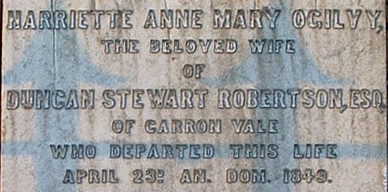
The brothers both served in the army and it was when serving in India, that Duncan met his future wife Hariette Anne Mary Ogilvy, youngest daughter of Hon. Col. Donald Ogilvie of Clova and Maria Morley.
(Hariette was born c1818)

Duncan & Hariette married in September 1844 and had 2 children:

Julia Cecelia Ogilvy Robertson, born 20th October, 1845
Donald Ogilvy Morley Robertson, born 21st June 1847
(Both at Edinburgh Parish, Edinburgh, Midlothian)

Both births are listed on the IGI (extracted entries from Parish Registers) and are again verified on Plaques in Larbert Old Parish Churchyard.


Two years after the birth of his son Donald Ogilvy Morley Robertson, Duncan Stewart Robertson was left a widower with two very small children after wife Harriette’s death on 23rd April 1849.
Duncan himself died 7 years later on 20th October 1856 age 37.


The whereabouts of Duncan at the time of the 1841 and the 1851 Census is unknown, but his two children, Julia and Donald were living at Balnaboch in Glenprosen, County of Angus with 2 Aunts:

(Balnaboch being the home of the Ogilvy Family)

30th- 31st March 1851
Dorothea Maria Ogilvy, age 25 Daughter of Hon. Col. Ogilvy, Landed Proprietor (himself* being absent), born Kirriemuir, Forfarshire
Clementina Julia Ogilvy, age 23 Daughter of Hon. Col. Ogilvy, Landed Proprietor (himself* being absent), born Kirriemuir, Forfarshire

*Himself being Dorothea and Clementina’s father, Donald Ogilvy. Their mother was Maria Morley, so they were the sisters of Duncan Stewart Robertson’s wife Harriette.

Julia C. O. Robertson, Grand-Daughter, age 5, born Edinburgh
Donald Robertson, Grand-Child, age 3, born Edinburgh

Dorothea Maria Ogilvy (of Clova) was an author and amongst her work
was a book of Poems published c1873.
She was born in c1826, died in 1895 and is buried in Cortachy Kirkyard.

Clementina Julia Ogilvy was born c1828 , married Kenneth Bruce Stuart , c1855, died 12th August 1857 and is buried in St. Cuthbert’s Churchyard, Edinburgh although her place of burial is unverified.

Duncan Stewart Robertson age 36, died of Broncho-Pneumonia at The Manse, Lochmaben,
Dumfriess-shire on 20th October 1856 where he was temporarily resident,
but whose last domicle was in the West Indies.
There is no occupation listed on the registration – only that he was a widower.

His parents were Duncan Robertson, M.D. & Susan Ann Jane Liddell
(formerly Robertson), maiden name Stewart.
His death was registered by Rev. Thomas Liddell, his step-father.


Susan Ann Jane Robertson (nee Stewart), Duncan’s mother married Rev. Thomas Liddell
on 16th November 1835.

The Death Registration shows his place of burial was Larbert Churchyard.

Carronvale was sold by his trustees to John Bell Sherriff in April 1857.
Presumably the proceeds would be split between his 2 children, Donald and Julia.

In 1861, 15 year old Julia is listed as a Boarder in Clifton, Bristol, England - perhaps a boarding school?

The other individuals listed were:

Maria Pines, age 48, School Mistress, born Wiltshire
Amelia Learmonth, Boarder, age 64, Holder of Dividends, born Middlesex
Charlotte Condreux, Boarder, age 26, French Governess, born France
Helen E. Harley, Boarder, age 16, Scholar, born
Julia Robertson, Boarder, age 15, Scholar, born Edinburgh, Scotland

In 1871, 25 year old Julia is listed as a Visitor
(visiting with the lady who had been her School Mistress ten years previously)
at 1 ‘Freemantle’? Villas in Clifton, Bristol, England.

The other individuals listed were:

Maria Pines, age 58, School Mistress, born Wiltshire
Emily Harwar, Boarder, age 30, Goverrness, born London
6 Female Boarders, all Scholars.
Julia Robertson, Visitor, age 25, Annuitant, born Scotland

By 1881, 35 year old Julia is listed as a Church Worker,
living at  8 Ellenbro? Crescent, Weston Super Mare in Somerset, England.

The other individuals listed were:

Isaac Penruddock, age 70, Clergyman, born Bath, Somerset
Eliza Penruddock, age 54, wife, born Dublin
Elizabeth Penruddock, age 30, Daughter, born Ahton Keynes, Wiltshire
Julia Robertson, Visitor, age 35, Church Worker, born Scotland


1891 finds, 45 year old Julia is back in Scotland.
On the 1891 Census listed as living at ‘Winfield’, Whitsome, Berwickshire with 2 servants,
‘Living on Private Means’

1901 finds, 55 year old Julia has returned to England,
and on the 1901 Census she is living with 2 servants at 8 Arundell Terrace,
Weston-Super-Mare, Somerset,  again listed as ‘Living on Own Means’

Julia Cecelia Ogilvy Robertson died age 66 on the 12th November 1911.
Her death was registered at Axbridge district, Somerset (October - December Quarter)

Donald Ogilvy Morley Robertson is more difficult to follow
as he doesn’t seem to appear on the 1861 Cencus.

According to the information on the Plaque in the Robertson Enclosure in Larbert Old Parish Churchyard he married ‘Alice’.

At the time of the 1871 Cencus, Donald (age 23) and Alice M. L. (age 22)
were living at 29 Longford Street, Pancras/Marylebone, London.
His occupation is listed as ‘Writer of Guide Books
Donald’s place of birth is Edinburgh, Scotland, Alice’s as Frome, Somerset.’

By the 3rd/4th April 1881, when the next Census was taken,
the couple were living in Witham, Frome, Somerset.
Donald is listed as age 34 and a Gentleman of Independent Means
His wife is listed as Louisa. (Perhaps Louisa was one of Alice’s middle names?)


The couple appear not to have had any children and although listed on the Larbert Plaques,
both are buried at Witham, Somerset.


The Robertson Family Enclosure in Larbert Old Parish Churchyard, Stirlingshire.

James Peter Robertson, born at Larbert on 26th January 1822, younger brother of Duncan Stewart Robertson and youngest son of Dr. Duncan Robertson and Susan Anne (or Anna) Jane Stewart spent most of his life in military service.

He attended Edinburgh Military Academy where he studied military drawing and surveying and it was whilst at Edinburgh, he received a commission and was gazetted to the 31st Regiment in 1842.
His service took him to Asia, South Asia and India as well as serving throughout the Indian Mutiny
and Crimean War.


His book ‘Personal Adventures and Anecdotes of an Old Officer’ was published in 1906
and was dedicated to the Rt. Hon. R. B. Haldane, M.P., Secretary of State for War
“In grateful remembrance of the life-long friendship that existed between the author
and his noble-hearted and worth father, the late Robert Haldane of Cloaden.”

James was 81 years old when the portrait below was painted.


Lieutenant Colonel, James Peter Robertson, C.B., J.P.  died at his home at Callander Lodge,
Callander on Friday, February 25th 1916 age 94 years.
His Death Registration shows that he was the widower of Louisa Churchill.
(Louisa is believed to have died c1910)

Obituaries appear in:
 The Glasgow Herald of  February 28th, 1916 (Page 6)
The Falkirk Herald of 4th March 1916

A well as being an Indian Mutiny and Crimean War Veteran,
he was a Justice of the Peace for Perthshire
and at the time, the oldest Freemason in Scotland.

The Falkirk Herald also adds that he was a “keen sportsman both with rod and gun” and “at the age of 85 he could take a twenty-mile run on his bicycle without undue fatigue.”

It is unknown if James is buried in the Family Enclosure at Larbert
as there are no existing Burial Records for the Churchyard.


Saturday, 1 October 2011

George Smith

There are numerous cast-iron grave markers in the Larbert Old Churchyard and although most of them are in a very poor condition, there are a few which have survived remarkably well.

Most of these are thought to have been produced by the Sun Foundry which specialised in producing iron-work for cemeteries. The most popular appears to have been in the style of an arched cast-iron frame with a sandstone or marble inset, so George Smith’s obelisk is considered to be very rare.


The above 3 photographs show how quickly nature can take over!

The obelisk sits within a fenced-off area and is possibly considered dangerous, so whether there were additional insets it is impossible to say.

The one remaining inset is in very good condition.

The Monumental Inscription is as follows:

"Erected to the memory of
GEORGE SMITH
Who died 6th July 1833 aged 43 years
And his beloved wife
ELIZABETH WILSON
Who died 30th July 1871 aged 81 years
Also their children
LAWRENCE and MARGARET
Who died in infancy
And ELLEN
Who died 10th March 1839 aged 21 years"

It is unknown what, or if there is any relationship between this George Smith
and the famous George Smith of the Sun Foundry, founded 1858.


The above 3 photographs illustrate some of the styles (and conditions) of the cast-iron markers.