Wednesday, 30 November 2011

Tools of the Trade

The following photographs are a small selection of some 17th and 18th century gravestones
showing carvings of symbols and emblems of occupations.

These stones are all from Graveyards in Central Scotland.

The appearance of occupational tools may or may not be new information to the researcher,
but can occasionally differentiate one generation from another.

 (Unless of course, sons followed the trade of their father and forenames were repeated!)

Blacksmith/Smith


Blacksmith/Smith/Hammerman


The addition of a crown represents being a member of the Guild of .. (that Trade)

Cooper


Cordiner (Leather Worker)


Hammerman


Maltman


Mason


Merchant


Miller (Mill Rind)


Sailor/Ship Owner/Ship Master/Mariner


Tailor


Weaver


The following photographs show many stones have carvings of more than one single trade.


Please note that these photographs are simply to illustrate ‘typical’ symbols.

Stylized variants and numerous combinations are commonplace.


www.memento-mori.co.uk

Monday, 28 November 2011

Rhindmuir House

Once upon a time, Rhindmuir House was a family home sitting amongst stunning rhododendrons
and a mass of spring daffodils …


The history of Rhindmuir reaches back until at least 1703 when the birth of various children were recorded although there may have been a ‘settlement’ of sorts at this time as the fathers were listed in the early records as weavers, masons and various other trades.

Research points to the earliest (if not the first) owner of the house or neighbouring farm
which was also called Rhindmuir, being Matthew Morthland,
Chair of Oriental Languages of the University of Glasgow.
He was born at Glasgow on 28th March 1714, son of Charles Morthland and Rabina Brisbane

Matthew married Anna Simpson, daughter of John Simpson, Doctor of Divinity
and Jean/Janet Stirling, on the 15th April 1742.

Their 9 known children:
(Father listed as Matthew Morthland of Rinmuir,
then as Writer to the Signet on and after the birth of John in 1751)

Charles, born at Glasgow in 1744
Jane, born on 6th March 1747
Rabina, born 9th April 1749
John, born 14th January 1751
James, born 29th January 1753
Matthew, born 5th December 1754
Alexander, born 7th November 1755
Mary, born 12th November 1758
Charles (2), born 16th September 1760
Janet, born 4th July 1762

At the same time as Matthew and Anna’s children were born, there were also births registered
of children born onwards of 1745 to John Stirling of Rinmuir,
but who lived in the house and who lived in the farm remains unknown.

‘Rinmuir’ appears on the 1747-1755 Roy Military Survey of Scotland Map.

A lair/plot in the name of Matthew Morthland exists in Shettleston Old Churchyard.
The inscription is as follows:

Rhindmuir Lair
Purchased by Mt. Morthland from (Uc? C ..ittie?)
Upon the 5th day of June 1765


Matthew Morthland was amongst the promoters for the building of the Monkland Canal
and is listed as being Treasurer of the Company when work began in 1770 to construct the canal.

James Watt the famous engineer and inventor, was commissioned to build the Canal and in his published Journals, mentions dining with Matthew Morthland on numerous occasions.

Matthew Morthland died in 1787

During the following years, various published maps list property owners beside their lands and residences. Thomas Richardson’s 1795 map shows the name of Andrew Stirling beside ‘Rinnmoor’, then on William Forrest’s 1816 map, the name beside ‘Rinmuir’ is Professor Mylne.

The Glasgow Courier of 11th June 1803 carried an advert as follows:
‘Lands of Rinns, Rinmuir & Coats for sale’

These ‘lands’ were purchased at this time by Robert Pollok (or Pollock)
who subsequently left it to his second son William Pollok.
William Pollok (born c1789) married Ann Whyte and the couple had 8 children.

Their eldest son being George Pollok, born at Cathcart, Glasgow on the 23rd September 1813.

William Pollock was in ownership the lands of Rhinds and Rhindmuir in 1829 when he died.
It is stated in his will that the lands were purchased by his father Robert Pollok
from Thomas Jackson of Coats, Trustee on the sequestered estate of John Gardner,
late of Rhinds and included Rhindmuir Mansion.

The following images from William Pollok’s Will, verifies the details:


The family may have used the house as a ‘country retreat’, but it is not until the Census of June 1841, that it becomes clear that there was both a Rhindmuir House and a Rhindmuir Farm
(as well as various lodges around the estate).

Living at Rhindmuir House (1841)
George Pollok, age 25, Independent
William Pollok, age 20, Independent

Living at Rhindmuir Farm
Hugh Wallace, age 40, Farmer, born c1801, Lanarkshire
Also, wife Elizabeth and children John, Mary and Alexander

William Pollok died c1849

On the 1851 Census, George Pollok aged 37 is still living at Rhindmuir House.
He is Head of the Household, his occupation listed as Landed Proprietor and J.P. for Lanarkshire.
With him are his sister Margaret Pollok, age 29, Proprietess
His brother Robert Pollok, age 24, Retired Commission Agent
His elder sister Ann (now Mrs. Jamieson), age 42 and his niece Margaret Jamieson age 4

In 1859, George Pollok joined the 29th Corps of the Lanarkshire Rifle Volunteers, was appointed Lieutenant in 1860 and although he resigned from the ‘29th’ in 1861, he later became Lieutenant of the 95th Corps.

The 1861 Census finds him still living at Rhindmuir House with his younger brother, details as follows:
George Pollok, age 46, Head of Household, occupation: Landed Proprietor
Robert Pollok, age 29, Brother, occupation: Portioner.

George remained single until the age of 53, when he married Christina Russell of Edinburgh, daughter of William Russell, Wine Merchant and Euphemia (or Espate) Tully.

The couple continued to live at Rhindmuir House until George’s death on 20th March 1892.

He was buried in Sandymount Cemetery in the Springboig area of Glasgow.


The inscription is as follows:

GEORGE POLLOK of Rhindmuir
Born 23rd September 1813, died 20th March 1892
And his wife CHRISTINA RUSSELL
Born 30th January 1830, died 8th July 1916

Christina moved to Edinburgh and can be found on the 1901 Census,
living with her sister at 22 Lomond Road, North Leith.

Rhindmuir House was home to the Kerr Family on the 1901 Census, then,
in 1911 it was in the possession of John King, a widower,
his son Robert and two daughters, Margaret & Isa.
(John King Junior (his son?) lived in Rhindmuir Lodge
with his wife Eleanor and their 2 young children)

Rhindmuir passed through various families in more recent times
and although a Grade B Listed Building was eventually allowed to become derelict.
A fire in 1995 sealed it’s fate.


The site is now occupied by a number of ‘new’ houses.

Rhindmuir Farm was demolished to make way for the M73 Motorway around 1975.


Sunday, 27 November 2011

Martyr’s Stone

Situated on the A803, Kirkintilloch to Kilsyth Road.


The following extract has been transcribed from the book
‘A Cloud of Witnesses for the Royal Prerogatives of Jesus Christ’

Although not in Kirkintilloch Parish, it is so well known that an account of it is requisite.

It is about two miles from the cross of Kirkintilloch, on the side of the road leading to Kilsyth, just when entering a part of the road which is shaded by rows of large trees on either side and about three quarters of a mile to the east of Inchbelly Bridge.

The original monument is a flat stone, six feet by three, and alongside of it is the new one.

The stone was erected in commemoration of James Smith and John Wharry (or McWharry), younger brother of the Laird of Scorryholm, a small property on the Logan Water, south-west of Lesmahagow.

In May, 1681, Alexander Smith of Cambusnethan was seized and taken to Edinburgh on the charge of being at the Battle of Bothwell Bridge. Disguised in women’s clothing, he escaped from prison only to be re-captured. A party of soldiers were taking him again to prison when they were attacked at Inchbelly Bridge, in Campsie Parish by a few country people who rescued the prisoner. In the affray some were wounded on both sides and one of the soldiers killed. Alexander Smith was taken prisoner again in 1685, sent to Dunottar Castle from where he also escaped, was captured again in 1687 and kept in prispon till the Revolution in 1688 set him free.

The rescue party thereupon made off with their friend in the direction of Auchinreoch and the soldiers, who had been taken by surprise, rallied themselves and in great fury began to search the neighbourhood for any stragglers. Very soon they discovered John Wharry and James Smith sitting in a wood, and having made them prisoners, they carried them off to Glasgow.

The two men had been found unarmed, and the only evidence that could be brought against them was that they were discovered near the place of encounter, but this was considered sufficient; and as it was necessary to do something to awe the people of a district where, on two occasions a soldier had been killed, they were sentences to have their right hands cut off, and then to be hanged, and their bodies carried to Inchbelly Bridge, and there hung in chains.

This sentence was carried out on the day on which the circuit was to commence it’s sittings in Glasgow, and, no doubt, the execution added much to the impressiveness of the sitting.

Of the two martyrs, the historian says that “their carriage at their execution was cheerful and galland. John Wharry was ordered to lay his hand on the block, and, thinking they required him to lay his head down, he did so with much courage.”

Major Balfour thereupon angrily said “It is not your head but your hand we are seeking.” John answered, “He had then heard wrong, but was most willing to lay down not only his hand, but his neck, and all the members of his body, for the cause of Christ.”

When his hand was cut off, he was not observed to shrink, but holding up the stump with great courage, said “This and other blood will yet raise the buried covenants.” James Smith died in much peace and comfort, not in the least discomposed.

“When they were but half-choked (says the crowd of witnesses) they were cut down, and in that condition carried on two carts to Inchbelly Bridge. Some honest people had provided coffins for them, and caused bring them near, at which Balfour raged terribly, and caused break them in pieces.” The bodies were therefore, buried coffinless in the moss.

The inscription on the stone is as follows:

“Twas martyr’s blood bought Scotland’s liberty. Erected February 1865, in room of the old tomb-stone, by the people of Kirkintilloch and neighbourhood.

Original Transcription

In this field lie the corps of John Wharry and James Smith, who suffered at Glasgow 13th June 1683(5) for their adherence to the Word of God and Scotland’s Covenanted Work of Reformation. ‘And they overcame him by the blood of the Lamb, and  by the word of their testimony; and they loved not their lives unto the death,’ (Rev. xii. 2.)


Halt, courteous passenger and look on
Our bodies dead, & lying under this stone;
Altho’ we did commit no deed, nor fact
That was against the Bridgeroom’s contract.
Yet we to Glasgow were as prisoners brought
And against us false witnesses they sought.
There, sentence cruel and unjust they past
And then our corps on scaffold they did cast
There we our lives and right hands also lost
The pain was ours, but theirs shall be the cost
From Glasgow we were brought unto this place
In chains of iron hung up for a certain space
Then taken down, interred here we ly
From ‘neath this stone our blood to heaven doth cry
Had foreign foes, Turks or Mahometans
Had Scythians, Tartars, Arabian Caravans
Had cruel Spaniards, the Pope’s blood seed
Commenced the same, less strange had been the deed
But Protestants profest, our Covenants do
Our countrymen this bloody deed could do
Yet nothwithstanding of their hellish rage
The noble Wharry, stepping on the stage
With courage bold and with heart not faint
Exclaims, this blood now seals our covenant.
Ending, They who would follow Christ must take
Their cross upon their back, the world forsake.


Another version of the wording, slightly different from the above …..

Halt, passenger, read here upon this stone
A tragedy, our bodies done upon.
At Glasgow Cross we lost both our right hands,
To fright beholders, th’ enemy so commands;
Then put to death, and that most cruelly.
Yet where we’re slain, even there we must not lie,
From Glasgow town we’re brough to this place,
On Gallow tree hung up for certain space.
Yet thence ta’en down, interred here we lie
Beneath this stone; our blood to heaven doth cry.
Had foreign foes, Turks or Mahometans,
Had Scythian Tartars, Arabian caravns,
Had cruel Spaniards, the Pope’s bloody seed,
Commenc’d the same, had been less strange their deed.
But Protestants, once Covenaters too,
Our countrymen, this cruel deed could do:
Yet, nothwithstanding this, their hellish rage,
The noble Wharrie leapt upon the stage.
With courage bold, he said, and heart not faint,
‘This blood shall now seal up our covenant,’
Ending, ‘they who would follow Christ, should take
Their cross upon their back, the world forsake.’


Saturday, 26 November 2011

Dead Man's Pennies

It took over a year from the beginning of the First World War in 1914 before the British Government took the decision that some sort of official token of recognition and gratitude should be given to the next of kin of fallen service men and women.

In 1917 a public competition to design a commemorative token was announced in The Times newspaper and that the format should be in the form of a plaque.
The words ‘He/She Died for Freedom and Honour’ were to be included.

From over 800 entries, the design chosen was that of Edward Carter Preston of Liverpool – a 12 centimetre disk to be cast in bronze entitled ‘Pyramus’.


The individual elements of the design each had their own meanings:

Brittania, the personification of Great Britain holding Poseidon’s Trident, her head slightly bowed towards the named individual offering a laurel wreath, an ancient symbol of triumph or victory.

A striding lion symbolising the power and strength  of the British Empire crushing an eagle.
(The eagle representing the central powers)

Two leaping dolphins symbolising Britain’s naval power

Oak leaves representing strength and endurance.

No rank was shown in order that no distinction would be made, only the equality of sacrifice.

Out of the thousands and thousands of plaques and scrolls produced and sent out,
only 600 were issued to women.


The above scroll was sent out separately.
Some relatives returned the pennies as they felt insulted as this could never replace the life of a loved one whilst others treasured them.
The practice of having them mounted on Family Gravestones became quite common as can be seen on the photograph below, although many of these seem to have disappeared/are missing.
This of course could be due to unsuitable adhesives being used and the plaques have simply fallen off over time, or, as they’ve become popular ‘collector’s items’ (and can sell for quite a considerable amount of money), have been removed by ‘other’ means.


Names have been edited out of the photos of the still 'intact' plaques for obvious reasons!!


Saturday, 29 October 2011

Frederick Pattison Pullar, Bridge of Allan, Stirlingshire

The following is a transcription of an article written by James Chumley, (Challenger Office, Edinburgh) Secretary to Sir John Murray on 27th February 1901.

THE LATE F. P. PULLAR.

A melancholy interest attaches to the paper on the Scottish Lochs which appears in this number of the Geographical Journal and Scottish Geographical Magazine, owing to the tragic death of one of the authors, Mr F. P. Pullar, since the paper was passed for press.

On February 15, while several hundred persons were skating on Airthrey Loch, in the grounds of Airthrey Castle, near Bridge of Allan, the ice suddenly gave way, and a number of people were precipitated into the water. Mr Pullar, who was a strong, muscular young man and a powerful swimmer, at once rushed to the rescue of those who were immersed, plunging into the water and floating ice with his skates on. He successfully assisted three of them to land, and then went to the succour of a young lady who was in an exhausted condition. It is confidently asserted by spectators, some of whom were submerged in their efforts to assist, that he might easily have saved himself had he relinquished his burden : this he refused to do. He supported the young lady for some time, but before help reached them his strength failed, and they both sank, their bodies not being recovered till three-quarters of an hour afterwards. This sad event cast a gloom over the whole district, and great sympathy was expressed for his bereaved parents, and for his only sister, who had just left the ice before the accident occurred. On February 19 he was buried in Logie Churchyard, attended by an immense concourse of mourners, and amid every expression of sorrow and sympathy.


Frederick Pattison Pullar was born at Bridge of Allan on the 20th December 1875, and was the only son of Laurence Pullar, Esq., of The Lea, Bridge of Allan and his wife Ellen Ferguson Pattison, and was a nephew of Sir Robert Pullar of Perth. In his earlier years he was rather a delicate child, and much of his education was conducted at home under private tutors. Later on his health improved, and his education was continued at the Stanley House School, Bridge of Allan, and the High School of Stirling. Afterwards he attended the Glasgow and West of Scotland Technical College in Glasgow, where he exhibited a marked ability for mathematics, mechanics, and applied science generally. He ultimately entered his father's business, but devoted a good deal of his time to scientific pursuits and studies. By his frank and genial nature he became endeared to the large number of workpeople employed by the firm of Robert Pullar & Sons.


About five or six years ago, while cruising in his father's yacht, the Freya,, he, under the guidance of Sir John Murray, commenced to take an interest in oceanographical observations and problems, exhibiting a lively devotion to the practical work carried on at the Marine Biological Station, at Millport. He enthusiastically embraced the study of meteorology, and established at his father's residence at Bridge of Allan a complete meteorological observatory, his instruments including deep earth thermometers. He became a member of the Royal Meteorological Society and of the Scottish Meteorological Society, sending in reports regularly to the last-mentioned Society during the past five or six years. He presented a complete set of meteorological instruments to the Scottish Hospital which proceeded to South Africa last year under Professor John Chiene. A room in his father's house was fitted up as his own private workshop, in which he had many ingenious and interesting mechanical, electrical, and photographic contrivances, together with considerable geological collections. He was an enthusiastic cyclist, and within the last year or two had three or four kinds of motor vehicles. He had an intimate knowledge of these machines, and his advice was frequently sought by automobilists; indeed, he proceeded to the scene of the disaster in a motor car, which was standing at the side of the loch when he met his death. He was an Associate of the Institution of Mechanical Engineers, and an active member of the Automobile Club.


About three years ago, in conjunction with Sir John Murray, he undertook a systematic bathymetrical survey of all the lochs of Scotland, and here his mechanical knowledge and inventive genius were at once exhibited by the improvements he made in the apparatus for taking the soundings. A portable machine was constructed from his designs, which could be firmly and rapidly fixed to the gunwale of the boat from which the soundings were to be taken. He also carried out many improvements in the methods of taking temperatures by means of deep-sea thermometers, in the plungers used for procuring samples of the deposits, and in the apparatus for the capture of organisms at intermediate depths. At the time of his death, among other improvements, he had in contemplation the construction of a motor engine which could be applied to the propulsion of both a car and a boat, so that he might carry with him from his home a boat for taking soundings, transfer the engine to the boat, and re-transfer it when the work was finished to the car again.

The publication of the results of the researches in the Scottish lochs was commenced last year, the first instalment, dealing with the lochs of the Callander and Trossachs district, being published in the Geographical Journal and Scottish Geographical Magazine in April last; and the present number contains a further instalment, dealing with the remaining lochs in the Forth basin. The survey of some other lochs has been completed,but the results are not yet in a state for publication.


In September last Sir John Murray left Britain for the purpose of carrying out explorations on Christmas Island, in the Indian Ocean, and it was arranged that the paper in this Number should be put into form and passed for press by Mr Pullar, with assistance in the Challenger Office. Sir John Murray returned to London on the evening of February 16, and on arrival at his hotel was handed a telegram announcing the death of his young friend on the previous day. They had made arrangements to devote most of the coming summer to the sounding of the lochs, with a view to the speedy completion of the entire survey : this important work will necessarily be interrupted by Mr Pullar's lamented death.

Mr Pullar was elected a Fellow of the Royal Geographical Society in 1896, and he was also a Fellow of the Royal Scottish Geographical Society ; last month he was admitted to the Fellowship of the Royal Society of Edinburgh.

Mr Pullar was beloved by all who knew him. He was a man of great bodily and mental activity, lively disposition, generous and brave, knowing no fear. His friends were justified in believing that a great future lay before him. His promising career has been cut short by an act of devotion. He sacrificed his life in an heroic endeavour to save the life of another.

His life was gentle ; and the elements
So mix'd in him, that Nature might stand up
And say to all the world, ' This was a man !'

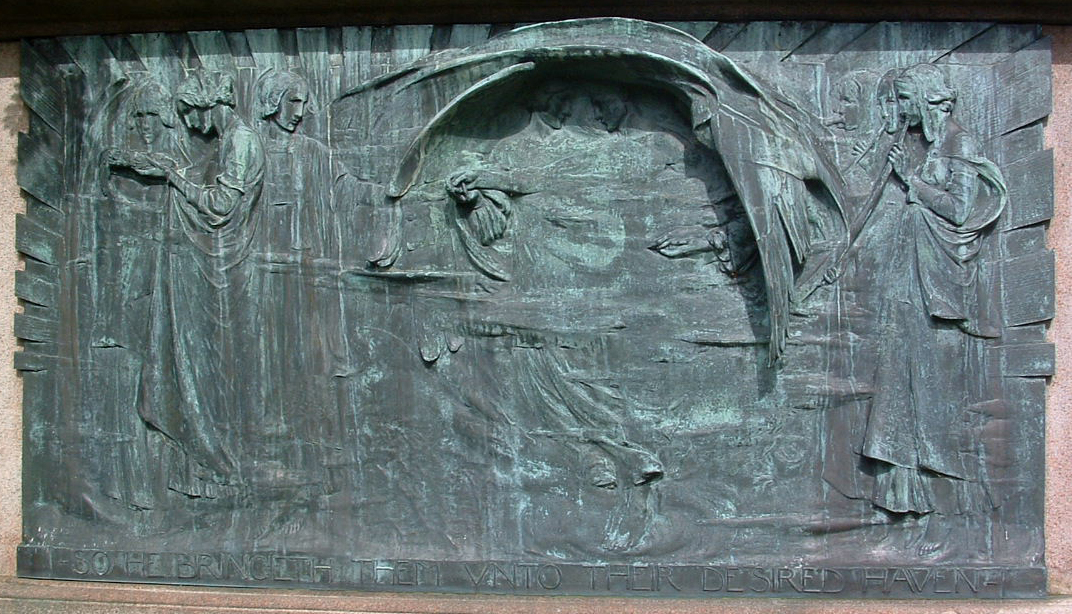
Logie Kirk

The Memorial Bronze on the Pullar stone in Logie was by Sir G. A. Frampton, R.A.

Further information on the Bathymetrical Survey of the Fresh-Water Lochs of Scotland
can be found at the National Library of Scotland, see:
http://maps.nls.uk/bathymetric/information.html